
Benchmarking & Comparative Approaches
Methodology
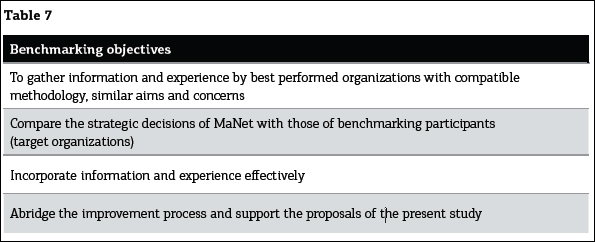
The identification and study of best performances of non-competitive organizations within the cultural heritage industry constitutes the basic preparatory stage in order to develop an enhanced, efficient and effective Strategic Plan. The criteria for their selection are based on their compatibility with the MaNet objectives. Consequently, external benchmarking was performed based on the one-to-one method as described by Tim Stapenhurst (2009:26-34,63-64). This method focuses on the identification, study and adaptation of the best performance among the existing best practices in short time as well as the dipolar relationship between the initiator and the benchmarking participant bares high learning potentiality. Subsequently, the one-to-one benchmarking method is enhanced by functional benchmarking, as their combination produces the highest value according to Bjorn Andersen & Per-Gaute Pettersen (1996:7). The functional benchmarking enables MaNet to benchmark prospective partners in the same industry that are easily accessible and share common or similar concerns. The above benchmarking tools were considered the most suitable drivers for the MaNet Strategic Plan as they enable to accomplish the benchmarking objectives presented in Table 7 (Stapenhurst 2009:5,18,26,80-81; Andersen & Pettershen 1996:6).
Supra Local: Nansa Valley (Spain-State of the Art)
The research project for ‘Evaluation Proposal of the Regional Heritage of Nansa Valley’ is identified as the state of the art and the most methodologically compatible exemplar for the MaNet Strategic Plan. The Botín Foundation in Catabria has designed an innovative, successful, future-oriented and globally implemented research model of rural development and regional activation. Its strategic plan of action was prepared to achieve ‘community sustainability’ by proposing realistic alternatives for economic development and quality of life of the inhabitants. The programme succeeded in accomplishing its ultimate goals through the implementation and execution of several key decisions and methods. First and foremost, its philosophy is based on the contemporary approach of ‘regional intelligence’. Regional intelligence was used as a tool to strengthen both intangible aspects and the local business based on the region and to maximize their added value by implementing the regional strategy in accordance with the anticipated socioeconomic changes (Lecha-Marzo 2012:13-36; Richards & Hall 2010:1).
Taking the advantage of universal implementation of Nansa Valley’s action model, MaNet could transfer practices relatively straightforward. However, it is very important to note that legal, socio-economical and financial aspects differ between the regions in question. As a result, only the ‘key success points’ of the benchmarking are proposed as a means for improvement (Agora Urban Institute 2013):
Local: Gjirokaster (Albania)
The geographical, natural and cultural contiguity of Gjirokaster and Mastorochoria as well as the potential for future collaboration between the regions are the major reasons for the examination of the particular territory from the perspective of benchmarking. The function of the non-profit organisation CHwB was benchmarked through the fieldwork in Gjirokaster. The reason MaNet paid particular attention to the newly established private organisation is related to its reliable and successful actions and to a similarity of objectives. The MaNet shares many of the ideas, goals and aims of CHwB, which concern the safeguarding of tangible and intangible heritage of stone craftsmanship, to raise awareness at a local and inter-local level, to increase cultural consciousness of local communities and to encourage collaboration and partnership with public sector and institutions for the safeguarding of the craftsmen’ cultural heritage.
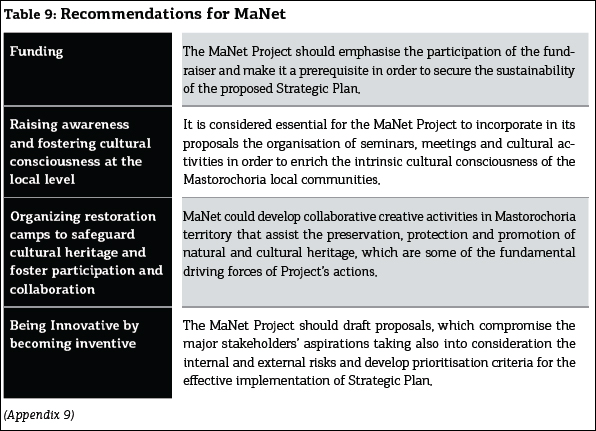
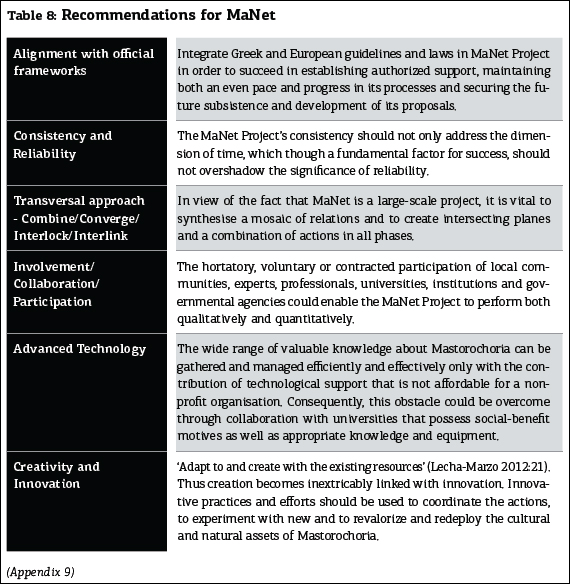
Taking into consideration the above benchmarking analysis, we are able to draw conclusions and proceed to suggestions for the MaNet Strategic Plan. In a dynamic area with a profound but also damaged cultural and landscape heritage, the network becomes the datum line where all the decision-making proposals and actions are articulated. The perception of ‘network’ is multidimensional as it accumulates all the intangible and tangible assets of the cultural heritage and of the society as well as legislative, macroeconomic and microeconomic parameters. This holistic approach could lead to profound knowledge of the area and its values. Alongside to network, the ability to generate intersecting links of the strategic actions, based on innovation, creativity and invention, facilitates and secures the transversal approach of the Project. The most successful tactics for economic development and strengthening or enhancing the dynamism of the territory are those that develop recreational actions, support the traditional activities of production, the exploitation of natural resources, and recognize alternative ways of economic activation, such as tourism or the industrialization of local products. It is important to stress that the support of social fabric secures the success of any action. The planning and the organisation of seminars, meetings and cultural activities raise the awareness of the local communities and make them active holders of the Project’s actions.