

LOCAL CULTURE of CRAFTSMEN as the MaNet INTELLIGENCE
Local Craftsmanship as the Territorial Intelligence
The scope of the MaNet Strategy is to design a coherent future-oriented plan. A prerequisite for such a result is to fully understand every aspect of the Mastorochoria territory through the passage of time. The driving force behind this perspective is the important culture that emerged from the activities of craftsmen who lived and interacted in this multicultural region. Their knowledge, which is interwoven with the evolution of these communities, was a product of absorbed traits from prior cultures combined with the ability to adapt and exploit creatively the natural environment. In other words, to paraphrase the ethnographic thought of Howard Morphy, a distinguished academic of Anthropology, we argue that ‘the landscape is redolent with memories of other human beings’. Eventually, as ‘[t]ime was created through the transformation of ancestral beings into place, the place be[came] for ever the mnemonic of the event’ and the ancestors ‘became part of the place for ever [...], they turned into the place’. Morphy’s claim in his essay is that ‘[t]he ordered, frozen world of the ancestral past becomes part of the subjective experience of the individual, through the acquisition of knowledge of the ancestral past as he or she moves through the world’ (Ganiatsas 1996:103-104; Hirsch & O’Hanlon 1995:188-189). Thus the slow pace of these procedures resulted in a dynamic cultural capital becoming a latent form of intelligence that was integrated into the Mastorochoria as part of the landscape. A landscape, which is not just a ‘passive receptor[r]’. In contrast, it represents a filter which distilled distinct changes and concrete evolution ‘according to their Genius Loci’. This significant capacity to cope with changes in various aspects of life is almost identical to the concept of “regional intelligence”. ‘Regional intelligence can be defined as the capacity of a region to both anticipate socioeconomic change and manage the knowledge derived from such change for the purpose of developing policies’. This concept is introduced by the European Association of Development Agencies (EURADA), an advisory body that aims to promote regional economic development (2004:1). Hence, this innovative approach based on the designated heritage of the Mastorochoria territory, as a common thread that has defined the collective identity of the communities, ‘is recognised as a precondition for individual and social well-being […] and for sustainable development, as well as a resource conducive to economic activity’ (COE 2008:30; Drury 2002:13; Ganiatsas 2011b:25).
Local Knowledge as the Foundation of the Craftsmen Culture
An indicative description of aspects of the lives of the Mastorochoria master craftsmen is of great importance. The narratives of the people that were interviewed, combined with previous ethnographic researches, untangle the web of life of the eminent craftsmen to the present day. The necessity to capture a comprehensive image of the territory led this analysis to focus initially on those aspects that were crucial for forming this specific culture. In this approach the notions of space and time are at the coreof the life and culture of Craftsmen9 (Nitsiakos 2003:13-14).
The ‘odyssey’ phenomenon of travelling and communicating with other cultures peaked during Modernity, as demographic and economic difficulties forced people to search for complementary alternatives that could pull them out of the impasse. The landscape’s limited resources from agro-pastoral activity were not viable. However, the same Mastorochoria landscape could provide ample amounts of stone and wood suitable for constructions. People efficiently exploited these alternative resources and developed their skills in the construction industry of the time, serving the needs of the wealthy castes. As an activity that could not be carried out during the cold winter months, this restriction linked their life with cyclical time10. Spring and winter were milestones: the former symbolized the departure of the male population for places where new constructions were in demand, the latter stood for the return and the serenity of the home. At a symbolic level the two equestrian saints, Saint George and Saint Demetrius respectively represented these cyclical milestones. These cycles established a sense of stability and balance, while communities formed their culture within a context of slow time, in accordance with reproduction in nature (Petronotis & Papageorgiou 2008:646; Nitsiakos 2008:123; 2003:123; 1998:70; Makris 1981:13). This specific combination of stability and mobility, which was harmonious with nature and its appropriation, transformed the social life and the hierarchy of the former agro-pastoral communities. Organized in guilds11 the craftsmen managed to protect their interests and at the same time to gain important privileges from the Ottoman governance system. Those privileges enhanced their economic and consequently their social status. However, being closely tied with their communities, they used their resources to guard their traditions and to protect their historical values, their extended families and the kinship networks in general. The guilds (‘Bouloukia’) established a strict hierarchy and division of labour. The ‘Bouloukia’ comprised specialized craftsmen, unskilled assistants and apprentices, mainly based on kinship networks12. However, the participants were obliged to follow a set of unwritten customary laws and a certain code of values. The Masters (‘Protomastores’) were in charge of every aspect of collective life and work, since tangible and intangible13 capital, as well as sociopolitical connections were in their hands. Thus they decided upon the synthesis of the ‘Bouloukia’, the projects they were going to work for and the money they were going to be paid. The masonry guilds, the ‘Koudarei’, were so tightly-knit that they even developed gradually a code language, called ‘koudaritika’, to protect their interests from their employers and their competitors. This coherent organizational framework functioned as a model for the social structure of the Mastorochoria communities and their social hierarchy, reflecting the productivity hierarchy. The craftsmen guilds adjusted their strict hierarchies and structures incrementally according to the needs of each historical context, but the ‘Protomastores’ always enjoyed the respect of the people and were on the highest professional and social level. Beyond kinship networks that ensured trust and confidence among its members, the guild model of the ‘Bouloukia’ organization also involved practices such as contractual relationships and monetary exchange. This signalled the transition from the embedded economy of self-sufficiency to a disembedded economy of capitalism, ushering in the era of Modernity for the communities. Therefore, the social values14 of the Mastorochoria communities contribute ‘to processes of cultural affiliation’ (Ziogas 2010:13; Papaioannou 2008:211; Petronotis & Papageorgiou 2008: LIV,677; Nitsiakos 2004:38-40; 1998:45,72-75,103-104,123-125; 1995:174-177; Tore 2002:11). The division of labour was a trait of the ‘Bouloukia’ organizational model. Moreover, the division of labour according to gender was one of the distinguishable traits of these mountainous societies. As the ethnographic research of the craftsmen culture progressed, the traces of their existence led us to the crucial role of the women. While the ‘Bouloukia’ appropriated the capitalist economic system and enriched their experiences and their knowledge with cultural capital from the places they visited, the female population of Mastorochoria was dedicated to serving the demarcated land of their homelands and became depositaries of local customs and traditional ways of life, expressing the notions of stability and conservatism. Women were bound up with the land, the houses, the children and the elderly. The survival of the communities depended on them. They alone had to take care of the livestock, as well as the fields and production, so that their families had food and heating throughout the year. In these remote slopes, where winters were harsh and long, cutting wood, sowing and harvesting, managing food supplies, the art of the loom, raising children and countless more duties of extreme difficulty were aspects of the everyday life of the heroic Mastorochoria women. Hence, as most people admitted, the real economy of these communities was managed by women in a self-sufficiency framework. Their life as an ‘exceptional testimony’ to a civilization which is now under the threat of extinction has significant cultural15 and economic value (Katharios 2012:39-41; UNESCO 2005; Nitsiakos 2004:37; 1998:70; Liatsi 2000:26-29;).
All the aforementioned traits are still imprinted in all the local communities’ customs. ‘[M]yths and rituals, which are vital for social reproduction’, are proof that ‘the appropriation of nature presents material as well as spiritual dimensions’. Moreover, they are ‘cultural processes that articulate experience’. In this light, the life around the craftsmen activity and their periodic mobility created a body of specific customs, which, with minor differentiations, were common in the whole Mastorochoria area. The most directly related to the crafts of masonry and carpentry were the customs of foundation laying and roof construction. Both had a ritualistic character and both were linked with the sanctification of space and the protection of the building. Animal sacrifice in the building foundations or at a village inauguration was related to ancient rituals that represented the creation of life out of death. Despite the intangible aspect of these customs, the craftsmen often claimed that rituals also had a tangible and very material nature. At times when resources were extremely limited, offerings, in food and clothing, were vital for the livelihood of the ‘Bouloukia’. In this context, various superstitions were reflected in similar customs and enriched the folklore tradition. There was also a differentiation in terms of importance for the social life of the communities among common customs and festivities in the Mastorochoria. All the important events, like engagements, weddings and celebrations took place during the winter, when all craftsmen had returned to their villages. They would even attach importance to minor saints in order to honour important saints by the same name. The symbolic and spiritual value16 of their traditions was present in the cycles in the lives of the craftsmen. As winter receded and nature awoke, the ‘Bouloukia’ began preparing for their departure. The routes of the craftsmen were accompanied by the sounds of migration songs and blesses from valediction customs. Women and children saw the craftsmen out of their villages or came forward to meet them at a certain liminal location, a ritual that was colored with ambiguous feelings of separations and welcoming, and named accordingly17. The rich musical tradition of Mastorochoria is a reflection of the events and feelings connected to the migration procedures of these communities. A variety of them describe the feelings of those who left as well as of those that stayed behind. These melancholic songs were so popular that they were even sung at wedding ceremonies and big festivals. Songs and traditional dances, as a mechanism that manages time and reproduces continuity, as well as the liminal milestone of space and time of valediction signaled the starting point of the craftsmen’s routes. (Rapoport 2010:240; Skourtis 2009:25-30; 2007:43-49; Petronotis & Papageorgiou 2008:646; Nitsiakos 2008:14,122,141; 2003:168; 1998:77-78; Ganiatsas 1996:103-104; Makris 1981:13; n.d.:2-3).
Tracing the Routes of Traditional Crafts
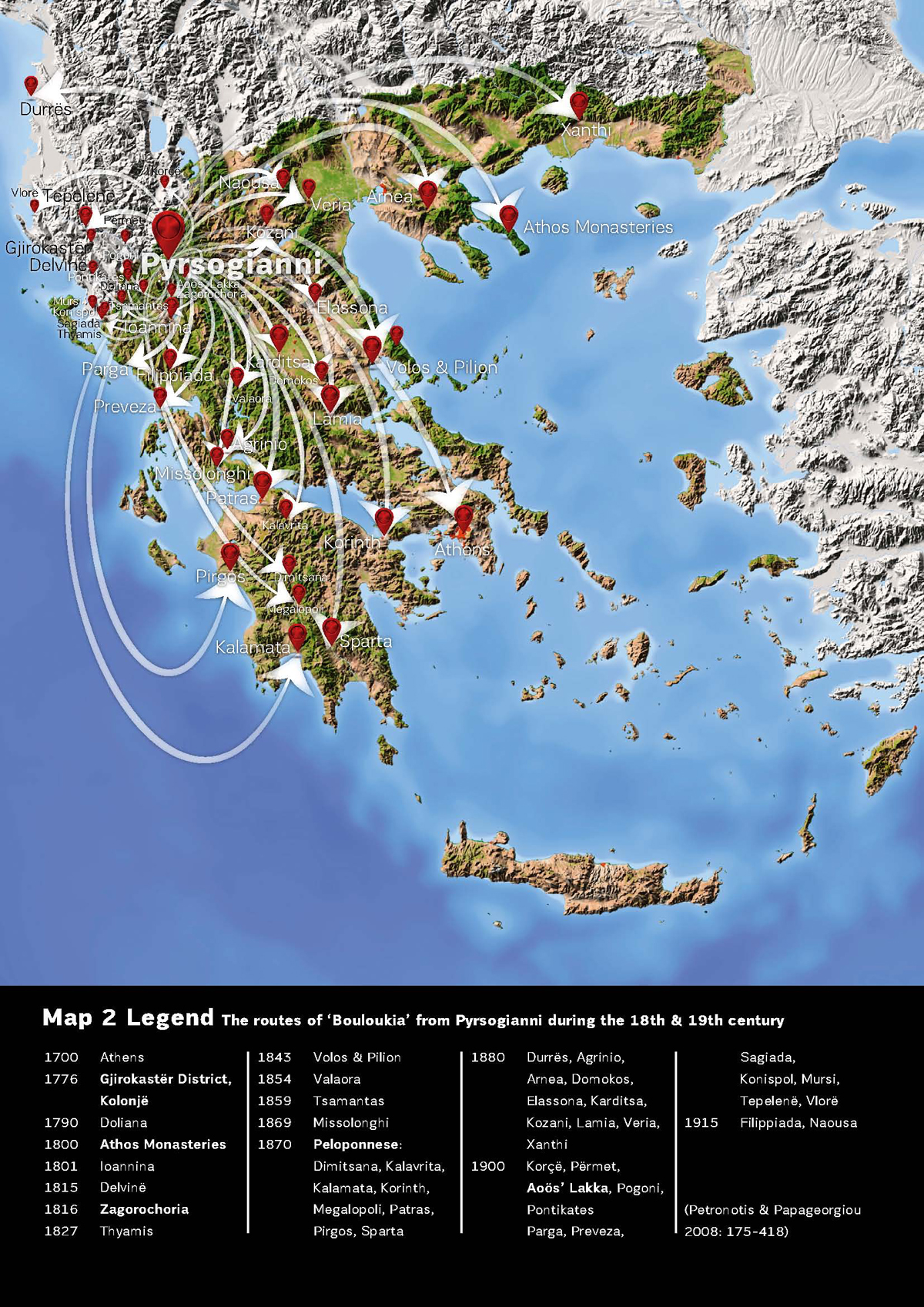
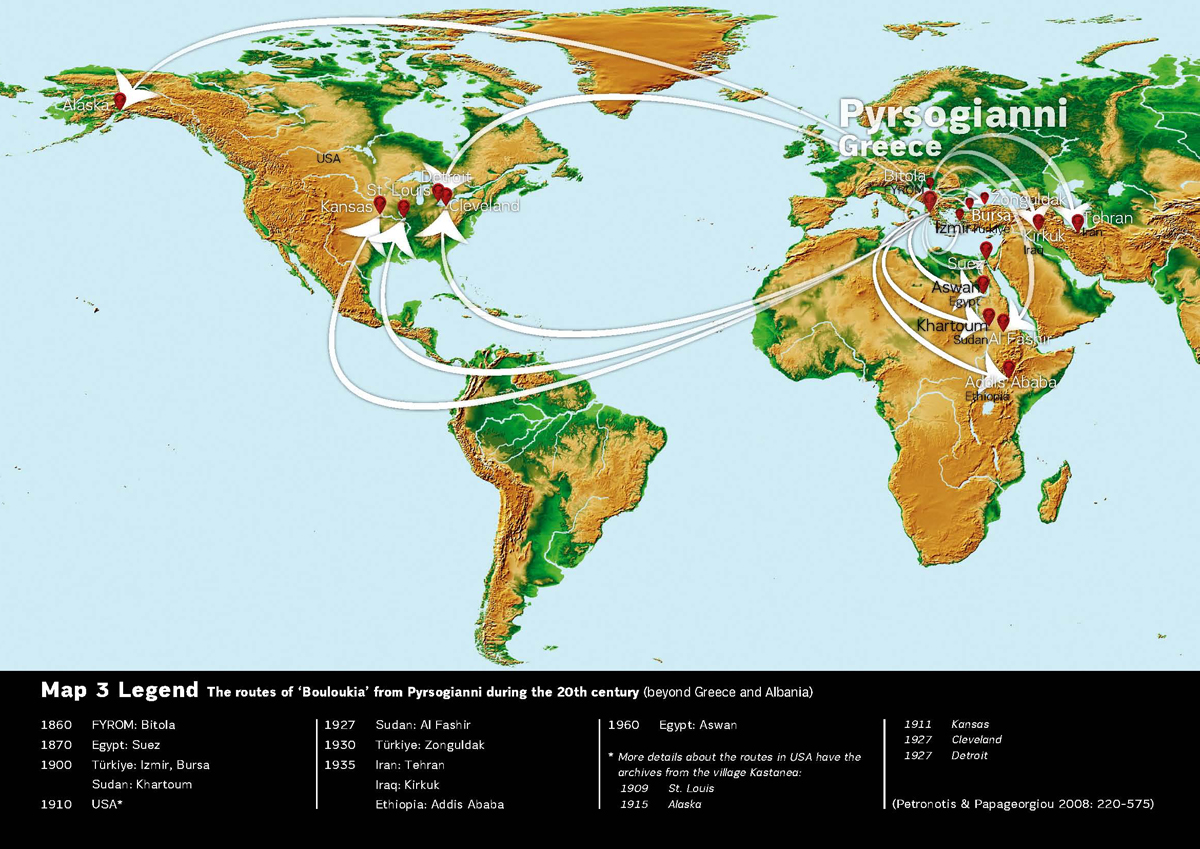
The Historical and Landscape Analysis have already underlined the fact that the area of the Sarantaporos glade was of extreme importance since the first organized communities inhabited the slopes of Smolikas and Grammos. This passage, that connected the Ionian and the Aegean seas and facilitated the communication and the commercial activities when Epirus was a crucial crossroad at the heart of different empires, is engraved in multiple itineraries. The road networks of the past are almost invisible nowadays and only ruins and archival references speak of their existence. The routes became ‘marginal compared to the most frequented’ and modern roads of the recent infrastructures. However, these networks were the basic itineraries of the ‘Bouloukia’ as the most appropriate means of diffusion for their marvellous art throughout the world. ‘The routes of craftsmen are of extreme importance because they outline both the contribution of the local techniques to the folklore art and the influences of other cultures to their art’ (Sorotou 2014: 92; Papageorgiou 2000:16). Moreover, the study, the research and the emphasis on these routes within the context of the MaNet Strategic Plan, ‘is an indispensable tool to understanding the traditional system’, while at the same time pinpoints locations with significant strategic value regarding the network (Lecha-Marzo 2012:17,144). In order to build ‘the correct perception of spatial reality in its growth and changes’ about the scale and the dimention of the significant craftsmen culture, MaNet recorded the routes of the ‘Bouloukia’ of the Pyrsogianni’s masonry craftsmen (Map 2,3). As one of the best representatives for masonry crafts, Pyrsogianni is still one of the oldest, though very well preserved and active18, village of the Mastorochoria. These characteristics reinforced the efforts of locals who act through the ‘Progressive Union of Pyrsogianni’ to collect precious data and artefacts. The maps of the routes of ‘Bouloukia’ from Pyrsogianni ‘constitute a way of generating knowledge’ and provide a clear image of the magnitude of their importance in local and global level (Papaioannou 2008:207; Principe 2002:28; Torre 2002:20).
Today, the life of the craftsmen and the achievements of this local knowledge, that have always respected nature and human need, are the legacy, the foundation, the common thread that promotes the local communities to a smart, sustainable and inclusive growth following and even leading the Hellenic, European and Universal vision for the
future (COPTA 2011:5).
9 Society and the dimensions of space and time are linked by definition with the case of the appropriation of nature. The historical context of Modernity in the area of Mastorochoria has actually been formed by these changes in the appropriation of nature that created new means of production and established a new social framework (Nitsiakos 2003:14-15).
10 Cyclical time is a trait of cultures which depend on natural procedures and base their economy on primary production activities that are by definition linked to the seasonal cycle, which also limits their economy to a self-sufficiency model (Nitsiakos 2003:120-121).
11 According to some researchers, the organizational model of painters from Hioniades is an exception. Kitsos Makris argues that those painters continued the structure of ‘fares’, which were social groups formed by patrilineal succession. His research proved that until the end of the 18th century painters originated from just two ‘fares’, Paschalades and Maridades. This particularity was due to the strong livestock traditions (1981:20-24).
12 A typical form of ‘Boulouki’ of masonry craftsmen was constituted by 1-2 hewers -the best was usually and the ‘Protomastoras’-, 1-2 skilled builders, 2 or more appendices, 1-2 workers that brought stones from the quarries and 3-4 assistant kids. This synthesis changed depending on the scale of the projects they worked for. There were projects that demanded even 50-100 craftsmen (Papageorgiou n.d.:138).
13 ‘Protomastores’ were the most talented and skilled craftsmen, regardless of social status. However, being at the top of the professional hierarchy was synonymous to socioeconomic power, which gradually enhanced their status in every relationship (Nitsiakos 2004:38).
14 This social value of Mastorochoria is also evaluated in accordance with UNESCO criteria of Outstanding Universal Value. Thus, the culture of the craftsmen can satisfy criterion (iii), ‘to bear a unique or at least exceptional testimony to a cultural tradition or to a civilization which is living or which has disappeared’ (UNESCO 2005).
15 This cultural value of Mastorochoria is evaluated as the social value in UNESCO’s terms (UNESCO 2005).
16 The symbolic value lies in inscriptions with symbols that protect the house from evil, churches with pictures that offer miracles, sacrifices for the building of bridges and buildings in general. This value is also in accordance with the, UNESCO’s Outstanding Universal Values for world heritage sites, criterion (vi): ‘to be directly or tangibly associated with events or living traditions, with ideas, or with beliefs, with artistic and literary works of outstanding universal significance’. Moreover, as Mara del Tore argues, ‘spiritual values can emanate from the beliefs and teachings of organized religion’ (Rapoport 2010:240; UNESCO 2005; Tore 2002:12).
17 As already mentioned, Klapsodendro (crying tree), Klapsochorafo (crying land parcel), Derti (heartache), Anathema (curse), Pikrokerasos (bitterness treat), are some of the toponyms of these liminal spaces toady bring to mind the hardship of migration (Nitsiakos 2008:14).
18 Pyrsogianni has 200 permanent inhabitants and was the administrative centre for the former Municipality of Mastorochoria (Papaioannou 2008:207).